Showing posts with label history. Show all posts

Tuesday, April 8, 2025

Rees Williams and his chums go to Gainesville

Leon High School
Leon High School of the 1920s (State Archives of Florida)

High school athletes with one or more track and field seasons in their history know how difficult it is to get to State. Of course, we're talking about qualifying for the State Championship Meet. But once upon a time, in the days before easy travel, getting to State was difficult in that transportation wasn't a simple problem. In 1920, the trip to the State Champtionship Track Meet in Gainesville, Florida from Tallahassee was an adventure--such an adventure, that one Leon High School student felt compelled to write about it for the school newspaper, The Hill Top. The article ran on 30 April 1920, less than two weeks after State. The day of their departure, 16 April 1920, this short notice ran in The Hill Top:

The track team left today to attend the State High School track meet at Gainesville. We just know they are going to come back with honors and Leon High will be proud of them.

Those going were: Rees Williams, Alton Towles, Orion Parker, Burton Williams.

Now that we know the names of the players, here is what one of them wrote about their trip to State.

The Hill Top
Volume 1, Number 8
Friday, 30 April 1920

"Rees Williams Wins Ribbon At Track Meet"

We left for Gainesville about four-thirty on Friday morning [April] the sixteenth (a long time before daylight it seemed to us).

The Quincy track team was also on its way to the "meet," so we had companions that we were acquainted with even if they were rivals. As soon as we were well started we composed ourselves as best we could to sleep a little, tho not much. We changed cars at Lake City about 9 o'clock and had breakfast there.

Robert Parker, in ordering breakfast at the cafe, ordered, among other things, two eggs which were listed on the bill of fare as "two eggs, any style, 20 cents." So when asked by the waiter whether he wanted them fried on one side or both, Robert insisted that he wanted them "any style," just as they were listed.

After changing cars twice more we arrived at Gainesville about 1 o'clock. We were met at the depot by some autos which took us to the hotel where we were to stay while in the city. Some of us were to stay at the College dormitories and some in private homes.

Saturday morning came with a promise of a fair day. We were certainly glad, because the track was wet and slippery from Friday's rains. The preliminaries of 100 and 200-yard dashes and also the hurdles were run off Saturday morning and then we stopped for the noon hour.

Finals to all the events were to come off that afternoon, so of course there was a great deal of excitement. The grand stand was packed with a crowd from different schools cheering for their favorites.

The boys taking part in the different events outwardly appeared as calm as usual, but the air was charged with a nervous tension, especially to those who were waiting for their events to come off.

The high jump and broad were over with, the mile and half-mile had been run, and still our team had no points.

We were feeling rather badly, but we still had one hope yet--that of Rees in the pole vault--and we certainly were not disappointed even when he tied with another boy for fourth place at nine feet. But we were greatly relieved to see him clear the bar at nine feet two and to see his opponent fall.

The medals and blue ribbons were awarded that night at nine-thirty. We left next morning at six, and again stopped at Lake City for breakfast, and speaking of eating, you ought to have seen us then, because it was late and we were surely hungry.

On the trip back we again had the Quincy boys for company and with some friendly scraps and tricks played on each other, we arrived here about 330, and whether you believe it or not, Tallahassee sure looked good to us.

Travel seems to have been by train. The trip to the meet took eight-and-a-half hours, so the average speed was somewhere in the range of 15-20 mph. By comparison, today's school buses seem marvelously swift.


Florida's State Meet goes back to 1915 and possibly earlier. The FHSAA wasn't founded till 1920 (Leon High was a charter member), so this was either the last non-FHSAA State Meet or the first FHSAA State Meet. There would be another 55 years before FHSAA sanctioned a girls' State Meet, although the Florida State College for Women hosted a state championship track meet for high school girls for several years during the 1920s. 1920, by the way, was the first year of publication for The Hill Top. No byline appears on the article, but Rees Williams (c/o 1921) was the circulation manager of The Hill Top. Draw your own conclusions.


Rees Williams had placed in the pole vault. It wouldn't be until 1922, two years later, that a Tallahassee athlete won an event at the State Meet. That year, Clifford Blitch of Leon (c/o 1922) won the 100-yard dash in 10.2--the State Meet record at the time. In 1927, Billy Chittenden of Leon (c/o 1927) won a State title in the pole vault, Rees Williams' event, going 10' 9-3/4", while also winning the high jump in 5' 10".


Since 1920, Tallahassee athletes have run faster, jumped higher, thrown and jumped farther. Neverthless, they are all following in the footsteps of Williams, Towles, Parker, and Williams.


Links #3175

Thursday, April 16, 2020

Kent Mills was Florida State's Marathon Man at Boston in 1960

Monday, 20 April 2020, won’t be a typical Patriots’ Day in Boston, Massachusetts. Because of CoViD-19, the bars won’t be open. The Red Sox won’t be playing in Fenway Park. The Boston Marathon won’t be run, rescheduled for 14 September 2020. And with no Marathon, there will be no one at the starting line in Hopkinton from Tallahassee, Florida.


Kent MillsTallahassee athletes have been racing the Boston Marathon for quite some time. In fact, back on Patriots’ Day 19 April 1960, Florida State University junior Kent Mills made the trip from Tallahassee to Hopkinton for the 64th annual Boston. It was what Tom Derderian, a historian of the event, described as “A perfect day for running. A 15-mile-an-hour tailwind on a clear, brisk 50 °F day.” Taking advantage of the conditions, Mills ran 2:48:59, placing 26th overall.


It was a smaller race then, with only 156 starters. Of those, 83 finished. Among those who dropped out along the way was John J. Kelley, the 1957 Boston champion. The 1960 race was also one of three Olympic Trial Marathons for the United States team. In spite of not finishing, Kelley was placed on the U.S. squad. It was a different time.


For Mills, Boston wasn’t his first marathon, nor his fastest. In fact, Mills was already a national marathon champion, in spite of having only been a runner for less than three years.


Growing up in Pontiac, Michigan, Mills hadn’t run in high school. He took up the sport as a freshman at Florida State University during the 1957-1958 academic year, coached by Mike Long. Mills raced the half-mile that year, running 2:01. Even in the 1950s, that performance wasn’t NCAA All-American material. But Mills’ future was in the longer distances. As a sophomore he set the Florida State school record in the two-mile run, going 9:31.4 during the 1959 track season.


Florida State didn’t have a cross-country team in 1959, so late that fall Mills made his own way into Alabama for the third annual Troy Chamber of Commerce Cross-Country Meet. The meet was hosted by Troy State coach Nick Costes, the 1955 US national champion in the marathon and a member of the 1956 US Olympic Marathon team. If Mills hadn’t been thinking about the marathon already, he was now. And the AAU was hosting the National Junior Marathon Championship in Atlantic City, New Jersey on 2 January 1960.


“The team couldn’t afford to send me,” Mills told the school newspaper, the Flambeau. “The University doesn’t sponsor a cross-country team, and the track team was in no position to pay my way up. I wanted to run so bad I could taste it...I had never run the distance before, but I wanted to try.”


So Mills spent nine days of the winter break hitchhiking north, spending seventeen hours on the road. He made it to Philadelphia at 2:00 AM on 27 December 2020, just eleven hours before the start of the Middle Atlantic Road Runners’ Club Cross-Country Championship. Mills won that 10,000-meter race in 33:51.


After spending nearly a week in Philadelphia, Mills found a ride with another athlete heading to Atlantic City for the Marathon. He trailed during the first half of the out-and-back route. With ten miles to go in the 26.2-mile race, Mills moved up into the lead group. He began to push the pace after that, dropping the rest of the leaders.


“I thought, ‘This can’t be right, I can’t be winning this race,’” Mills told the Flambeau.


Nevertheless, Mills won the race by over half a mile, taking the national title with a 2:30:35. At the end of the year, it would stand as the eighth-fastest marathon by an American during 1960, an Olympic year.


The day after the race, Mills started hitchhiking back to Tallahassee.


Unlike the Junior National Marathon, Boston was in the middle of track season and in the middle of Florida State’s spring session. Mills still made it to Massachusetts for the race, but his 2:48:59 was well off what he had run in his first marathon. Several of the athletes he had beaten in Atlantic City were among the 25 runners ahead of him at Boston. Six days later, Mills was back in Florida, racing at Gainesville in the FSU-UF dual meet. He took third in the mile and second in the two-mile for the Seminoles. Florida State won that day, and the team went undefeated during the 1960 season.


Mills spent another year competing for Florida State before graduating in 1961. He did not log any more marathon victories as a Seminole. But if you’re ever in Hopkinton on the starting line of the Boston Marathon, remember that Kent Mills was there before you.


Links
#2697

Thursday, January 29, 2015

The peculiar athletic career of Douglas Parish

J R Alford GreenwayAfter the State of Florida acquired the J. R. Alford Greenway in 2000, the land has become available for public recreation, including running. The Greenway has been the site for several cross-country races, including the 2013 Iota Tau Alpha Run For The Tape. Some folks wondered why no one had staged a race their sooner. Well, who was to say they hadn't? The land had been around much longer than the current generation of runners. Cattle pastures, cotton and tobacco plantations, and Native American villages had all occupied portions of the Greenway over the centuries and millennia. So I invented a fictional nineteenth-century athletic event for the park:

In the 1850s the land was part of the plantation of Wallace Chaires. Chaires would hold an annual cross-country run for his slaves each autumn. The winner received a hog and was excused from the cotton harvest. Understandably, the tradition did not survive the Unpleasantness of 1861-1865.

A good story has to have some roots in the truth, so that's where I sowed my story. There was never (so far as I know) a Wallace Chaires, but the Chaires family had been active in the area. The village of Chaires is just a few miles east of the J. R. Alford Greenway, and a plantation house belonging to the Chaires family had stood on the Greenway itself before being burned to the ground during the Chaires Massacre of 1838, an action in the Seminole Wars. The Chaires family had been planters and slave owners. I'd never heard of southern planters racing their slaves, but the English gentry used to stage races between their footmen, so it seemed plausible.


I didn't realize just how plausible till I was browsing Clifton Paisley's The Red Hills of Florida, 1528-1865 and read about Douglas Parish. Paisley reported that Parish had been a Jefferson County slave that had been entered in races against other slaves by his master, James Parish. Paisley's source had been a 1936 interview of Douglas Parish collected in the Federal Writers' Project Slave Narratives. Here are some excerpts from that interview:

Douglas Parish was born in Monticello, Florida, May 7, 1850, to Charles and Fannie Parish, slaves of Jim Parish...

As a small boy Douglas used to spend his time shooting marbles, playing ball, racing and wrestling with the other boys. The marbles were made from lumps of clay hardened in the fireplace. He was a very good runner, and as it was a custom in those days for one plantation owner to match his runner against that of his neighbor, he was a favorite with Parish because he seldom failed to win the race. Parish trained his runners by having them race to the boundary of his plantation and back again. He would reward the winner with a jack-knife or a bag of marbles.

Just to be first was an honor in itself, for the fastest runner represented his master in the Fourth of July races when runners from all over the country competed for top honors, and the winner earned a bag of silver for his master. If Parish didn't win the prize, he was hard to get along with for several days, but gradually he would accept his defeat with resolution. Prizes in less important races ranged from a pair of fighting cocks to a slave, depending upon the seriousness of the betting.

So Douglas Parish was a runner, right?


But the story didn't hold up so well when I started looking for more information about Parish. I succeeded in turning up several census records for a Douglas Parish that was born in the 1860s, but none for a Douglas Parish born in 1850. If the census records were correct, Parish was indeed born into slavery, but was still a very young boy when Emancipation came. Unless James Parish and the other plantation owners were holding toddler races, Douglas Parish's athletic career had not been as a slave.


Before or after the Civil War, there may very well have been races. Douglas Parish may have run in them. The training may have been as described. How far was it to the edge of James Parish's plantation, anyway? What was Douglas Parish's mile time?


I have enough difficulty finding names and times for past winners of the Monticello Melon Run; answering these questions from the more distant past may be impossible. If nothing else, it seems that athletics has deep roots in this area.


Links

Tuesday, November 26, 2013

FSU vs UF track meet, 2 May 1981

Larry Green, John Rogers, Keith Brantly, Herb WillsOn Monday, 25 November 2013, Brett Hoffman shared a photograph from over thirty years ago showing a group of Florida State and University of Florida athletes racing on FSU's Mike Long Track. After some grumbling back and forth, a few of the Old Men of Florida Distance Running determined that the picture showed Larry Greene, John Rogers, Keith Brantly, and Herb Wills (yes, me) running in the 5,000 meters at the Florida State vs. Florida dual meet on 2 May 1981.


Very appropriate for this picture to surface five days before the annual Florida - FSU football matchup.


The track meet between the Seminoles and the Gators used to be an annual affair as well. I knew that it had been going on long before I had arrived at Florida State in 1978, probably for decades. FSU track and field had only been around for 30 years or so, but that much history seems like all eternity when you're college age. It was also true that FSU had a winning streak in the series when I started running with the Seminoles. By the time the 1981 meet rolled around, we had managed to extend that streak with wins in 1979 and 1980. The pressure was on to add another year. Never mind that we had finally managed to defeat UF in cross country earlier in the academic year. Head coach Dick Roberts called a team meeting to make sure we knew how important this was. This was a big deal in itself, because we didn't have many team meetings--maybe one more each season before the conference meet. Coach Roberts, though, was never the man to settle for finishing behind the Gators. In anything. We would beat them in every sport, then make sure we got better parking spots than they did at the grocery store.


I'm not sure how things turned out at Publix in 1981, but FSU outscored UF at the annual dual meet that spring, 85 to 69. Five of those points were mine, as you can see in the results below. You might also find a few other familiar names, depending on how familiar you are with the history of track and field in the Sunshine State. Walter McCoy, already an Olympian, is listed in a couple of events. I've already mentioned Keith Brantly. On that Saturday afternoon in 1981, Brantly hadn't yet run a marathon, but eleven years later he would make the U.S. Olympic Marathon team.


While going through the results I found a couple of obvious errors that I couldn't correct, and I may have introduced one or two more mistakes when I transcribed the document. I hope that won't prevent you from enjoying these results from the attic.

Florida State vs. Florida
Mike Long Track
May 2, 1981


Shot Put
  1. Ken Lanier (Florida State) 17.06 (55' 11-3/4")
  2. Neil Serafinas (Florida) 16.95 (55' 6-1/2")
  3. Harry Glenn (Florida State) 15.51 (50' 10-3/4")
  4. Bill Roncallo (Florida) 14.63 (48' 0")
Score: Florida State 6, Florida 3


Javelin
  1. Hank Langee (Florida State) 63.87 (209' 9")
  2. Joe Pascal (Florida State) 59.19
  3. Mark Nugen (Florida State) 58.63
  4. Rich Grobman (Florida) 54.73
  5. Harry Lekien (Florida) 46.35
Score: Florida State 15, Florida 3


Long Jump
  1. Stan Holmes (Florida) 7.66 (25' 1-3/4")...wind-aided +2.86
  2. Leon Hutchins (Florida State) 6.82 (22' 4-1/2")...wind aided +2.16
  3. Pfil Hunt (Florida State) 6.69 (21' 11-/2")
  4. Jerry Smith (Florida) 6.50 (21' 4")
Score: Florida State 19, Florida 8


4 x 100 Meter Relay
  1. Florida State (Chip Wells, Don Frost, Ronnie Taylor, Walter McCoy) 39.97
  2. Florida (Greg Robinson, Creighton Blahak, Hugo Miller, Floyd Brown) 40.21
Score: Florida State 24, Florida 8


3,000 Meter Steeplechase
  1. Doug Overfelt (Florida State) 9:01.88
  2. Todd Sinclair (Florida) 9:02.04
  3. Mark Sheehan (Florida) 9:11.96
  4. Marc Trigg (Florida State) 9:14.50
Score: Florida State 29, Florida 12


1,500 Meter Run
  1. Cullen Mattox (Florida) 3:51.51
  2. Robb Gomez (Florida State) 3:51.73
  3. Dave Strahl (Florida) 3:55.50
  4. Bobby Shackleford (Florida State) 3:57.39
  5. Chuck Broughton (Florida) 3:59.80
  6. Pete Nachtigal (Florida State) 4:11.90
Score: Florida State 32, Florida 18


110 Meter Hurdles (wind was under allowable standard)
  1. Greg Robinson (Florida) 14.1
  2. Chris Jackson (Florida) 14.3
  3. Walker (Florida) 14.8
  4. Leo Hodges (Florida State) 15.1
Score: Florida State 32, Florida 27


400 Meters
  1. Walter McCoy (Florida State) 47.94 [sic]
  2. Ron Nelson (Florida State) 47.30
  3. Creighton Blahak (Florida) 47.51
Score: Florida State 40, Florida 28


100 Meter Dash (wind was under allowable standard)
  1. Chip Wells (Florida State) 10.49
  2. Floyd Brown (Florida) 10.58
  3. Donnie Frost (Florida State) 10.61
  4. Hugo Miller (Florida) 10.71
Score: Florida State 46, Florida 31


Triple Jump
  1. Leon Hutchins (Florida State) 15.38 (50' 5-1/2")
  2. Lester Scruggs (Florida) 14.69 (48' 3-1/2")
  3. Sam Gates (Florida State) 13.85 (45' 5-1/2")
  4. Tanner Cronic (Florida) 13.76 (45' 0")
Score: Florida State 52, Florida 34


800 Meter Run
  1. Philip Rolle (Florida State) 1:49.4
  2. Chuck Broughton (Florida) 1:51.1
  3. Lynn Brown (Florida State) 1:53.0
  4. Rick Green (Florida) 1:53.9
  5. Mike Nardone (Florida State) 2:04.2
Score: Florida State 58, Florida 37


400 Meter Hurdles
  1. Kenneth Gray (Florida) 57.25 [sic]
  2. Leo Hodges (Florida State) 54.16
  3. Steve Davis (Florida) 55.47
  4. George McCallum (Florida State) 56.82
  5. Greg Robinson (Florida) 57.25
  6. Maury Burstein (Florida State) 57.4
Score: Florida State 61, Florida 43


Pole Vault
  1. Mark Bradley (Florida) 5.03 (16' 6")
  2. Rohn Stark (Florida State) 5.03 (16' 6")
  3. Dennis Nobles (Florida State) 15' 6"
  4. Al Stanley (Florida State) 15' 0"
  5. Todd Postylmayr (Florida) 15' 0"
  6. Kip Dingler (Florida) 14' 6"
Score: Florida State 65, Florida 48


200 Meters (Wind +0.70)
  1. Ronnie Taylor (Florida State) 20.81
  2. Floyd Brown (Florida) 20.98
  3. Walter McCoy (Florida State) 21.33
  4. Hugo Miller (Florida) 21.60
Score: Florida State 71, Florida 51


Discus
  1. Neil Serafinas (Florida) 55.52 (182' 4")
  2. Eric Joseph (Florida) 53.19 (174' 8")
  3. Harry Glenn (Florida State) 51.05 (167' 8")
  4. Scott McLean (Florida State) 48.0 (160' 11")
  5. Bill Roncallo (Florida) 46.99 (154' 4")
Score: Florida State 72, Florida 59


5,000 Meters
  1. Herb Wills (Florida State) 14:08.7
  2. Keith Brantly (Florida) 14:15.4
  3. John Rodgers (Florida) 14:35.5
  4. Scott Taylor (Florida State) 15:10.7
Score: Florida State 77, Florida 63


High Jump
  1. Sam Doherty (Florida) 6' 8"
  2. Sam Gates (Florida State) 6' 6"
  3. Tony Laszenski (Florida) 6' 6"
  4. Tadd Todd (Florida) 6' 6"
  5. Rohn Stark (Florida State) 6' 4"
Score: Florida State 80, Florida 69


4 x 400 Meter Relay
  1. Florida State (Ron Nelson, Philip Rolle, Ronnie Taylor, Walter McCoy) 3:12.3
  2. Florida 3:15.89
Score: Florida State 85, Florida 69


Links

#1031

Tuesday, July 2, 2013

South Georgia's Edwardian Era Marathon

[ Originally published in the July/August 2013 edition of The Fleet Foot, the newsletter of the Gulf Winds Track Club of Tallahassee, Florida. ]


Atlanta, Georgia has the oldest marathon in the southeastern United States. The Atlanta Marathon wasn't run until 1963, though. From this, you'd conclude that marathon running was late in coming to the South.


But the Atlanta Marathon is only the oldest existing marathon in the region. There were other races before Atlanta, they just aren't around any more. One of these was the Sylvester-to-Albany Marathon of 1912, preceding the Atlanta Marathon by more than half a century.


Notices of the Sylvester-to-Albany Marathon first started appearing in area newspapers during the spring of 1912. The Tifton Gazette ran this in their issue dated 14 June 1912:

Members of the Hikers club, of Sylvester, will participate in a twenty mile marathon, from Sylvester to Albany, the latter part of this month. The race starts at the Worth County Local office and ends at the office of the Albany Herald, $100 being offered in prizes.

The Gazette had the date wrong, though; the race was actually scheduled for 4 July 1912. The Thomasville Times-Enterprise took the race somewhat less seriously, running this a few days later.

The Mayor of Sylvester and the Editor of the Worth County Local are both qualified to take part in the big Marathon to Albany on the Fourth of July. The Mayor has already proven that he could run and the editor can tell how it ought to be done whether he gets there or not.

MapTwenty miles is well short of the 26 miles and 385 yards (or 42,195 meters) that we would call a marathon today. In fact, the course was only 19.7 miles long. But in 1912 it was only a short time since the marathon had been introduced at the 1896 Olympics as a 40-kilometer race. The Boston Marathon had just been run for the sixteenth time, each time at 24-1/2 miles. It would be over a decade before either of these iconic races moved to the 26 miles and 385 yards distance.


The seed of that official distance had been sown, though. The 1908 London Olympic Marathon, for complicated reasons, had been 26 miles and 385 yards. The dramatic collapse of Dorando Pietri, the win by American Johnny Hayes, and a cast of characters that included Arthur Conan Doyle and Queen Alexandra of England made for a great story. And because London, as the center of the British Empire, was at that time the media capital of the world, that story had gone around the globe by telegraph. Newspaper editors everywhere picked up the story, and when they had to explain to their readers what a marathon was, they glibly mentioned that "a marathon is 26 miles and 385 yards." Neither the International Olympic Committee nor the International Amateur Athletic Federation would have agreed, but the decision had been taken out of their hands. Those officials might as well have tried to redefine the length of a mile.


The 1908 Olympic Marathon race touched off a marathon craze that inspired many new marathons and a professional marathon circuit. Most of these new races were 26 miles and 385 yards long. Some folks didn't get the memo, though. The IAAF didn't make the new distance official until 1921, and Boston continued at 24-1/2 miles till 1924. Likewise, the Sylvester Hikers staged their 19.7-mile "marathon" in 1912. Maybe they just couldn't be bothered to find a less direct route between the two newspaper offices. Whatever their reasons, about the time the marathon craze was dying down elsewhere in the United States, it was just getting started in south Georgia.


Early on the morning of 4 July 1912, the runners set off from the headquarters of the Worth County Local in Sylvester. Before starting, each athlete had to pass a physician's examination. It was later reported that "one of the contestants of the race did not arrive at the starting point in time to undergo this examination and as the results of heart trouble he fell by the roadside exhausted and in a serious condition before the goal was reached." Sylvester's Joe Garrett had no such problem. Garrett was the first to reach the Albany Herald finish line of the marathon, a little less than 2-1/2 hours after leaving Sylvester. That's not quite as fast as 7:30 per mile, but the roads were not quite paved, either. The U.S. highway system was still years in the future; the Sylvester-to-Albany Marathon may have been more like 19.7 miles of cross country than like a road race.


The marathon was deemed successful enough that the race was repeated on 4 July 1913. There was no mention of the Sylvester Hikers this time; the Albany Herald and the Worth County Local were in charge of the show. Prizes totalling $200 were offered. It's not clear whether this was cash or merchandise; sources differ. Reports stated that "the race will be open to all amateur runners in Worth and Dougherty counties who were bona fide residents of those counties on May 15." Surely, amateur runners wouldn't be competing for cash prizes? The Amateur Athletic Union would have been interested. But the announced $100 for first, $50 for second, $30 for third, and $20 for fourth were handsome stakes for an era when the price of gold was pegged at $20 an ounce. Each athlete was charged an entry fee of $2. Furthermore, they would have to pass a medical examination by Dr. L. E. Welch of Albany the day before the race in order to be allowed to compete.


Marathon Day barbecueThe 1913 race was run in the opposite direction of the 1912 event; starting in Albany and ending in Sylvester. The competitors were expected to spend the night in Albany before setting out from the Herald offices at 5:00 AM on July 4. The early starting time must have been to avoid killing the runners with summer heat.


So in the dim morning hours of the Fourth of July, ten athletes pawed the street in front of the Albany Herald. Three other entries had failed to show up. At 5:09 AM the race was underway. Defending champion Joe Garrett set the early pace, but another son of Sylvester went with him, Elzie (or Elsie, or L. C.) Hancock. The two soon outdistanced the rest of the field. Hancock proved stronger in the end, reaching the Sylvester offices of the Worth County Local and the finish line first in 2:25:22. Garrett was runner-up in 2:29:41. J. P. Fulgham took third with a 2:54:46, and H. E. Redding was fourth in 3:22:52. The other six runners reportedly dropped out.


"Marathon Day" didn't end with the race. The Woodmen of the World barbecued over 3,000 pounds of meat for a lunchtime feast "at which the contestants in the big race and the officials will be the guests of honor." Later a special excursion train took Worth Countians to Albany for a minor league baseball matchup between Albany and Columbus of the South Atlantic League.


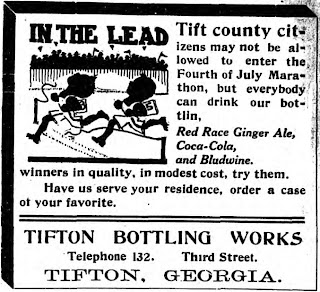
AdvertisementNot everyone in south Georgia had been happy with the 1913 marathon being restricted to athletes from Dougherty and Worth counties. A soda advertisement in the Tifton Gazette even mentioned the issue: "Tift county citizens may not be allowed to enter the Fourth of July Marathon, but everybody can drink our bottling, Red Race Ginger Ale, Coca-Cola, and Bludwine." So for the 1914 edition of the Fourth of July marathon eligibility was expanded to include the athletes of Baker, Colquitt, Dougherty, Lee, Mitchell, and Worth counties. This didn't increase the size of the field, though; there were still only ten competitors. Perhaps the higher entry fee of $3 discouraged participation. As in 1912, the 1914 race was run from Sylvester to Albany.


Also as in 1912, Joe Garrett won the 1914 marathon, this time running 2:44:30. Archie Hancock, brother to 1913 champion Elsie (or Elzie, or L.C.) Hancock, was runner up, followed by two Albany runners, A. R. Langford and J. E. Wallis. Once again, the rest of the runners apparently dropped out. If it looked like you weren't going to score one of the four cash prizes, then why bother to finish?


After 1914 the Herald-Local marathon disappeared. South Georgia’s marathon mania had lasted no longer than that elsewhere in the country. With the World War in Europe raging, no one needed stories about marathon-running south Georgia boys to sell newspapers. Later, some of those boys went away to the Great War. A few years after the armistice the IAAF declared the official marathon distance to be 26 miles and 385 yard, six-and-a-half miles farther than the Herald-Local marathon had been. The country roads between Sylvester and Albany where marathoners once trudged disappeared, replaced first by Georgia Route 50 and then by US 82. A shorter Fourth of July race on Peachtree Street in Atlanta appeared in the 1970s, eventually becoming Georgia's preeminent Independence Day running event. Albany got a new marathon in 2007, this one at the regulation distance. Sylvester became the home of Peter Pan Peanut Butter and settled for hosting a shorter race, the Peanut Festival 5K.


The building in Sylvester where the race started still stands, even though the Worth County Local moved out long ago. You can stand on the street outside and wonder what it must have been like a century ago to stand in that same spot, contemplating a pre-dawn run over red clay roads and across the Flint River to far-off Albany. Garrett, the Hancocks, and those other boys knew, but they've already run their last races.


Links

Tuesday, October 13, 2009

The Great Charleston Relay, 1908-1921

[ This was originally written for a state history for teacher institute that I was attending at the University of South Carolina in July 1991. Later that year it was published in The Lowcountry Runner, the newsletter of the Charleston (South Carolina) Running Club. Not that I can find my copy of that issue.... ]

During the latter half of 1908, America was gripped by a "marathon craze" inspired by the Olympic antics of Johnny Hayes and Dorando Pietri1. Communities around the nation staged marathon races for local talent. The South was not untouched by this phenomenon; New Orleans hosted a marathon race early in 19092. In Charleston, South Carolina, the local Y.M.C.A. cautiously considered doing something similar.

Early on, the idea of of putting on an actual marathon was discarded, because "only a few participate in that sort of athletic test. Again, experts agree that the 26 mile, 385 yards are too severe a strain on any but eager candidates for spiritual spheres."3 Certainly, they were overly concerned about the safety of marathon running, but the point about participation was valid. The Y.M.C.A. was trying to provide healthy sport for many youths, not just the few willing to train for a marathon. In the end, they decided to keep the marathon distance, but to have runners tackle it as a team rather than individually; i.e., a marathon-length relay. Such a relay retained the mystique of the marathon while keeping the amount each runners was doing down to a distance manageable by a casual young athlete.

The course chosen for the race went from Summerville to the Y.M.C.A. clubhouse in Charleston, a distance of 24 miles. Each team was to have 24 runners, one for each mile of the course. A runner could begin his mile when passed an eight-inch brass tube by the teammate preceding him. The winning team was the first to carry their tube through the doorway of Y.M.C.A. headquarters. As an added bit of drama, "a message of interest to the public" was contained in the tube, the message borne by winning team to be read by Charleston Mayor R. G. Rhett. The Y.M.C.A. had every intention of making the race an annual event, and a revolving trophy was furnished by James Allen & Company. The winning team would be awarded custody of the Allen Cup until the next year's race, and their name would be engraved on the Cup. Capturing the relay title three years in a row would earn a team permanent possession of the trophy.

It was a difficult race to organize. Four teams, from the College of Charleston, the Citadel, the Y.M.C.A., and the Porter Military Academy, were entered. The 96 runners representing these teams needed to be delivered to each of the 23 relay stations on the roads between Summerville and Charleston, as well as to the start at Summerville. Judges and timers also had to be transported around the 24-mile long course. Thus, a large number of automobiles were needed. Almost daily, appeals were run in he Charleston newspapers, pleading for the city's automobile owners to volunteer the use of their machines. Headlines announced the number of cars still needed. Articles declared that it was a matter of civic pride: "It is a poor sort of city that will not encourage clean amateur sports, and Charleston is not a poor sort of city by any means."4

Finally the logistics problems were solved, and early Saturday afternoon, December 5, 1908, a huge motorcade set out from the Y.M.C.A. building on King Street and headed toward Summerville, in all likelihood and even more exciting spectacle than the race itself. The start was scheduled for 3:00pm, but it was not until 3:25 that the lead-off men for each of the four teams were toeing their marks. The official starter, Mayor O. C. Sires of Sumerville, rode up on horseback.
"Are you ready?" called Mayor Sires from his saddle.
The runners set.
"One, two, three!" The white handkerchief floated to the ground, and the big race was on!5
Back at the Y.M.C.A. a crowd started to gather, occasionally informed as the race's progress by reports coming in over the telephone. Excitement grew. Finally, the anchor man for the first team came into view. It was Wigfall, wearing the red and blue of the Y.M.C.A. Over his shoulder was visible Klein of the Citadel. Wigfall dashed into the Y.M.C.A. building and his baton was handed to Mayor Rhett, who removed the message it contained and read it to the crowd: "Boost Charleston always and everywhere!" A cheer went up. Some five minutes after the Citadel team finished, the College of Charleston anchor man brought his team home in third place, with the Porter Military Academy team another minute back in fourth. The first annual relay was history.

Of the four institutions that fielded teams in the original relay, the College of Charleston and the Citadel continued to participate every year the event was held. The Y.M.C.A. and Porter Academy each sent teams annually until 1918 and 1919, respectively. They were joined in 1909 at the second annual relay by teams from Fort Moultrie and the Charleston Navy Yard, which competed under the names Army and Navy.6 A Navy team made up of athletes from a destroyer force stationed at Charleston ran in 1921. Over the years, teams also appeared from the Medical College of South Carolina, the Baracas S.S., the Gregorian Society, the Knights of Columbus (with which the Gregorians had merged), The Monarch Athletic Association, the West End Athletic Club, and the Y.A.A. (a team made up of runners from clubs who couldn't come up with enough athletes to field their own teams.7

After the Y.M.C.A.'s victory in the inaugural relay of 1908, the history of the relay became one of domination by the Citadel. The cadets won the race six years straight, from 1909 through 1914, winning permanent possession of the Allen Cup as well as a second cup the Allen company donated under the same conditions as the first. The Y.M.C.A. claimed its second victory in 1915, breaking the Citadel's lock on the event. The "Y" came close to repeating in 1916, leading the race as late as the last half mile, when Baynard, the anchor man for the College of Charleston, flashed by his Y.M.C.A. rival and proceeded to build a ten-second lead on his way to the finish line. In subsequent years, though, the Citadel returned to pre-eminence, piling up another five straight championships.

With four to seven teams competing in the relay each December, a great number of athletes would suddenly go into training each Autumn. Each team would have as many men as possible practicing to that there would be a large pool of runners from which to pick the fastest two dozen on the day of the race. It's hard to say just how many runners were out there disrupting traffic and scandalizing pedestrians with their "very light running suits,"8 but newspaper estimates of 500 to 600 are probably high. Reports of up to 40,000 spectators lining the course are also almost certainly exaggerated; photos of the 1911 race fail to show any spectators even on Meeting Street right in Charleston.9

Less experienced runners could turn to the News and Courier, where advice on training, form, and pacing were given by Herman F. Bretthauer, physical director of the Y.M.C.A. No doubt each athlete in the field pored over the course description printed in the newspaper a few days before the race. This was before the era of paved highways, and road conditions between Summerville and Charleston were highly variable. The week before the race, a scouting party would go out, mark each mile, place arrows at the turns, and note the condition of the course. Their full mile-by-mile report was what ran in the paper, and a runner could find out ahead of time just what to expect in the way of sand, mud, and hills. To a 1991 reader, the earliest course descriptions seem more like directions to a secluded hunting lodge than a report on a highway route. By the time the last race was held in 1921, the portion of the relay route in Charleston County, the latter ten miles, was entirely paved with stretches of concrete, asphalt, brick, wooden blocks, and Belgian blocks. But in Dorchester County the best road surface was gravel.

It was the state of the roads closest to Summerville that prompted the biggest change that the Y.M.C.A. ever made in the relay. In 1910 the course survey team found the first seven miles of roads outside of Summerville to be almost impassable. It was decided to cut the length of the relay to 15 miles. Rather than also cutting the size of each team down to 15 men, the distance of 18 of the relay legs was reduced from one mile to one-half mile.10 The following year, the roads were good enough that the full Summerville to Charleston course could be run, but in 1912 the relay again had to be cut to 15 miles. The roads were in poor shape for several years after 1912, and apparently the Y.M.C.A. gave up on even trying to hold a 24-mile event. 1911 was thus the last relay run from Summervile; after that the race was run from Otranto with the first six men on each team running a full mile and the remaining 18 men running a half mile. Other small course changes were made over the years, such as when the finish line was moved to the intersection of Meeting and George Streets, but the distance remained 15 miles.

The relay was continued over the years, uninterrupted even by World War I. Interestingly, the Boston Athletic Association Marathon was canceled on account of the war; it was replaced by a relay. But after 1918 the Y.M.C.A. was no longer competing in its own race; they announced that their role in athletics was now purely promotional. In 1922 the articles pleading for citizens to volunteer their autos for use in the relay were conspicuously absent from the Charleston newspapers. Instead a little piece appeared in the Evening Post on December 4, announcing that the date of the race was being moved to February 22 in order to allow more teams to get their runners in shape. It was felt that only the Citadel and the College of Charleston had been able to field teams of fit athletes in the past. When February rolled around, there was no relay. A fourteen-year story was over. Racing in the streets of Charleston continued for a few years, with the Citadel, the College of Charleston, and other teams meeting in events such as the annual Thanksgiving Day two-and-a-half mile race. But after 1925 the College of Charleston no longer fielded either a track or a cross-country team, and the cadets at the Citadel grew increasingly indifferent to track and field.

Road racing in Charleston was not dead, but slumbering. Each April the city hosts the Cooper River Bridge Run, a ten-kilometer event that ranks as the second largest road race in the southeast. But because Charleston's running tradition is not uninterrupted, it is unlikely that any of the thousands of participants in the Bridge Run realize that they are treading streets traversed decades ago by fleet young men each carrying a gleaming brass baton.


Appendix I: The 1908 Olympic Marathon and the subsequent "marathon craze"

The London Olympic Games of 1908 have been cited by many authors as a counterexample to the notion that the Olympics promote peace through friendly competition between nations. Anglo-American bickering that these Games was so open and intense that it began to overshadow the athletic events. Such was the situation when the marathon runners set out from Windsor Castle on a hot July 24 to cover the 26 miles and 385 yards to the Olympic Stadium.

It was an odd distance, neither an even number of kilometers nor an even number of miles. The race was in fact the longest Olympic marathon yet run. The start had been moved back to Windsor where the royal family could conveniently watch the runners toeing the mark. The location of the finish line had been similarly influenced, being placed directly under Queen Alexandra's box at the stadium.

The British entries all fell back early, and the first runner to enter the stadium was an Italian, Dorando Pietri. But Pietri was disoriented, suffering from the effects of having run 26 miles in the heat. He collapsed on the track, far short of the finish line. Officials helped him to his feet several times, but each time he staggered on just a little bit before collapsing again. Suddenly it became known that the second-place runner was Johnny Hayes, an American. The British sympathies were already with the plucky Pietri, and the prospect of one of the despised Americans taking the championship was too much to endure. Pietri was carried over the line a mere half minute before Hayes jogged across unassisted. The American team immediately filed a protest and Pietri was disqualified for having received aid during the race. Hayes was thus awarded first place and Americans also captured third and fourth place finishes. In recognition of Pietri's valor (and probably also to spite the Americans), Queen Alexandra awarded a cup identical to that given to the winner, Hayes.

Controversy and drama made this a famous race, creating a worldwide interest in the marathon. In the United States this interest was further enhanced by the sterling performance of the American marathoners. During the Autumn a series of professional marathons was established. These included rematches between Hayes and Pietri. Other notable marathoners such as Canada's Tom Longboat turned professional. There was also a proliferation of amateur marathons, and a renewed interest in established events such as the Boston Athletic Association Marathon. It is a measure of the influence of the 1908 Olympic Marathon on marathon running in general that years later, when an official length for marathon races was established, it was set at 26 miles, 385 yards, the distance run in London.


Appendix II: Results of the Charleston Relay, 1908 - 1921

1908
1.  Y.M.C.A.                      2:26
2. The Citadel 2:26 1/2
3. College of Charleston 2:31 3/4
4. Porter Military Academy 2:32 3/4

1909
1.  The Citadel                   2:20:53
2. U.S. Navy 2:22:03
3. U.S. Army 2:25:43
4. Y.M.C.A. 2:26:53
5. College of Charleston 2:33:34
6. Porter Military Academy 2:34:43

1910
1.  The Citadel                   1:14:30
2. U.S. Army 1:15:25
3. Porter Military Academy 1:16:37
4. Y.M.C.A. 1:19:10
5. Medical College 1:20:45
6. College of Charleston 1:20:50
7. Baracas 1:25:40

1911
1.  The Citadel                   2:19:30
2. College of Charleston 2:26
3. Porter Military Academy 2:26:30
4. Gregorian Society 2:27
5. Y.M.C.A. 2:27:30

1912
1.  The Citadel                   1:20:00
2. College of Charleston 1:22:00
3. Gregorian Society 1:22:04
4. Porter Military Academy 1:23:14
5. Y.M.C.A. 1:28:55
6. Monarch Athletic Association 1:30:00

Notes
  1. See Appendix I for an account of the 1908 Olympic Games marathon and its effects. Any good history of the modern Olympic Games will include a description of this race, but one of the best is in David Wallechinsky's The Complete Book of the Olympic Games. Dr. David E. Martin's The Marathon: Runners and Races is an excellent secondary source for information on the professional marathon circuit that flourished briefly after the 1908 Olympics, and other aspects of the "marathon craze."
  2. New Orleans Times Picayune, 22 Feb 1909. This race was only twenty miles long but it was billed as a marathon. It can be argued that it actually was a marathon, because no official marathon distance existed until the 1920s. However, most early marathons were in the neighborhood of 25 miles.
  3. Charleston News and Courier, 25 Nov 1909.
  4. Charleston News and Courier, 29 Nov 1908.
  5. Charleston Evening Post, 7 Dec 1908.
  6. The fourth runner on the Navy team of 1909 was listed as Nimitz. The researcher was not able to determine whether or not this was the future admiral, Chester Nimitz, who was a commander of submarines in the Atlantic as the time.
  7. See Appendix II for the performances of these teams. All times are given as they were recorded in either the News and Courier or the Evening Post. The 1910 time for the Porter Military Academy reflect a 3:45 handicap that was given to that team. The Evening Post reported that the same time for both West End A.C. and Porter in the 1917 race; the News and Courier did not run a post-race story that year.
  8. Evening Post, 8 Dec 1909; News and Courier, 23 Nov 1909.
  9. The 46th Annual Session, Porter Military Academy, Charleston, S.C., 1912-1913. pp. 34-35.
  10. Charleston News and Courier, 7 Dec 1910.

Tuesday, June 23, 2009

Tallahassee's turn-of-the-century track team

[ I wrote this in 1990. It was originally published in the April 1990 edition of The Fleet Foot, the newsletter of the Gulf Winds Track Club of Tallahassee, Florida. ]

In 1897 Dr. Albert Murphree, a young mathematician, came to Tallahassee to accept the presidency of the West Florida Seminary, a small state institution of higher learning. Under his energetic leadership the enrollment grew from a few scores of local scholars to over 300 students from all over Florida, and the legislature was compelled in 1901 to change the name of the school to the more modern Florida State College. Advertisements for the college boldly compared it to respected schools in the northeast.

Perhaps it was conscious imitation of those schools that motivated FSC to form a track team. At any rate, President Murphree was a strong believer in college sports and FSC had football and baseball squads as well. Our record of the earliest collegiate track team in Tallahassee (if not all of Florida*) is a small photo from the 1901-1902 edition of the Argo, the college's yearbook, of the 1902 FSC track team. Pictured are Francis Bayard Winthrop, Guy Louis Winthrop, Fritz William Buchholz, R. E. Turner, Irving James Belcher, Burton Elies Belcher, Robert Fort Bradford, Jr., J. L. Forehand, and two unnamed managers or coaches. The Winthrop brothers were of the same wealthy Leon County landowning family from which Winthrop Park derives its name. Fritz Buchholz was the son of Professor Ludwig Buchholz, a German immigrant and good friend of President Murphree. Bob Bradford was from the pioneering Bradford family for whom Bradfordville is named. The Belchers were Tampa boys, and as for Turner and Forehand, there is no indication that either of them were even students of FSC!


Unfortunately, there is no direct evidence that the FSC track team ever competed against athletes from another school. The picture and the roster is there in the 1901-1902 yearbook, but there is also a page devoted to the roster of a football team that certainly did not play--FSC's inaugural game was held in the fall of 1902 against a team from Bainbridge. An editorial in the Argo states grandly that "the formation of the Olympian Athletic Association opens a new era in college athletics here. No longer will FSC take a back seat in athletics in this State, but it may be safely prophesied that in a very few years she will rank foremost upon the track and field." This indicates that there was at least an intent or desire to take part in intercollegiate track and field competition, but leaves dangling the question of whether any meetings ever took place. Perhaps the answer lies in the records of one of FSC's athletic rivals: the South Georgia Military Institute in Bainbridge, the University of Florida at Lake City, the East Florida Seminary at Gainesville, Georgia Tech, and Stetson.

By 1903 the team's roster had swollen to ten, and although there was no photo of the thinclads in the 1902-1903 Argo, the opening page of the athletics section in that yearbook featured a drawing of three runners. However, in the fall of 1902 Florida State football opened in Tallahassee and much of the excitement the students had for the fledgling track program was transferred to the football team. Finally, all of Florida State's sports hopes were snuffed out by the state legislature; in 1905 the Buckman Act was passed, consolidating all the state schools into a women's college in Tallahassee, a men's university in Gainesville, a negro college in Tallahassee, and an institute for the blind, deaf, and dumb. The students at the women's school were denied all but intramural competition, and intercollegiate athletics in Tallahassee became confined to the teams of Florida Normal and Industrial College (present-day Florida A&M University).

Bob Bradford, incidentally, went to work in 1911 with his father, who had foreseen the downfall of cotton as a cash crop and moved into the the dairy business. The Bradford dairy operation remained one of the foremost in Leon County until 1958, when Bob's son moved it east to Jefferson County. No record remains of Bob Bradford's mile time, but maybe he was a discus thrower, anyway. Fritz Buchholz graduated with FSC's last class in 1905 and ended up in Gainesville where he became a prominent citizen, serving at various times as a teacher, coach, school principal, politician, and author of a book on the history of Alachua County. Buchholz High School is the second school in Gainesville to be named after him. Whatever became of the rest of the pioneering FSC thinclads, none of them were ever Olympic athletes; not until 1964 would Tallahassee produce an Olympian on the track.

* I have since learned that Rollins College in Winter Park had track teams at least as early as the 1890s.

Monday, February 12, 2007

Pedestrianism in old Tallahassee

[ Rescued from one of my old myspace blogs. ]


Originally published in The Fleet Foot, June 1989 (Vol. 14 No. 6)

FOOTPRINTS

Pedestrianism in old Tallahassee

By Herb Wills

On recreation in the old west, Louis L'Amour wrote that "social activity for families and many others centered around the churches, although there were dances, box suppers, horse races, as well as foot races (a very popular activity)...." Unfortunately, Mr. L'Amour never chose to portray this "very popular activity" in his western fiction, and the sporting events in his novels are usually limited to boxing matches. Tom McNab, former coach of the British Olympic track and field team and author of Flanagan's Run, recently published the first running western, The Fast Men, the adventures of two professional sprinters in the American west of the 1870's. McNab is a serious historian of the sport, and The Fast Men gives you a fair idea of what professional pedestriansism (the nineteenth century term for both competitive running and walking) was like in those days, at least so far as the gambling and other chicanery that went on. Through the 1930's, the story of professional running in America sounds less like Chariots of Fire and more like The Sting.

In 1879 Tallahassee was no longer under the threat of imminent Indian attack, but neither were most of the western settlements. That year the city hosted the first Middle Florida Agricultural and Mechanical Society Fair, half a mile north of what was then the city limits. These fairs continued annually until 1885. Local historians state that "footraces" were among the fair's events, but the Weekly Floridian for that period only mentions such an event as having taken place in 1879. At later fairs, athletics were apparently limited to wheelbarrow and sack races.

Unfortunately, no particulars about the 1879 race or races are recorded anywhere; the distance, times, and winners are all unknown. But an unusual race that took place a few days before the fair opened has been reported.

While the finishing touches were being made on the fairgrounds, a match race ("an exhibition of walkism," the Floridian reporter called it, apparently uncomfortable with the highfalutin' term "pedestrianism") was staged between a Mr. O'Harra and a trotting horse named Gracie D, both from out of town. Gracie D's best time over a mile was 2:26, so in order to make a race of it, O'Harra was to run a quarter mile (a half lap around the track) while the horse covered a half mile (a full lap).

The race began only an hour later than scheduled. O'Harra, resplendent in his suit of racing tights, moved to the far side of the track, while his equine opponent was led to its starting position on the near side. And then they were off. In the early going it looked as if O'Harra would triumph, but Gracie D caught him on the homestretch to win by ten feet. No one thought to time the event, but it must have taken close enough to 75 seconds that O'Harra was definitely running rather than racewalking.

O'Harra told a local reporter that "no three-minute horse" could beat him in such a contest. His plans were to remain in Tallahassee through the fair, presumably to take on the best of Florida's horses in similar competitions. But here the facts end; no such races were recorded.

Suppose that such an event did take place. The owner of a "three-minute horse" might enter his animal against O'Harra, but certainly not with the huge head start that Gracie D gave the ped. However, O'Harra's 75 seconds is not an impressive time for the quarter, even by nineteenth-century standards. Was he really that slow, or was he sloughing? Was the exhibition a set-up for a hustle? We have the lukewarm assurance of the Floridian that "there was no betting, at least none that we were aware of" on the original race, but even that would fit such a scheme. O'Harra and his handlers would have been content to hold their money and wager heavily on a later race with a local horse, perhaps with only a 330-yard head start this time....

But perhaps I slander O'Harra. No story made print concerning a later race, or fleeced Tallahasseans, or tar-and-feathered pedestrians. And I still don't know who won the footrace at the fair.